
Roy Dart: a quiet architect of rural development
Roy Dart passed away in April 2026, and I wanted to pause to reflect on—and celebrate—the quiet but profound influence he had on my career and on rural development more widely.
Roy was the kindest and most generous “boss” you could hope to have. It is no exaggeration to say he shaped my professional life in the rural economy at a time when the field itself was still finding its feet.
I first met Roy in the early 1990s as a young(er) adviser in ADAS Statutory when I joined a small young national team focussing on rural economy work. From the outset, he believed in our ideas and backed us completely. Our team was working in what was then seen as the poor relation to environmental programmes—but Roy never treated it that way. He knew rural development mattered, long before it became fashionable or mainstream.
With patience, tenacity, and an uncanny ability to bring people together, Roy helped us build early partnerships across the public and private sectors. We linked advice, training, and grant support for farm and rural businesses—often by driving and aligning organisations that had resources and funding when we did not. This collaborative, pragmatic approach laid foundations many now take for granted, and it was central to Roy’s vision of what rural development could achieve.
The real step change came with the arrival of the first EU‑funded rural development programmes—Objective 5b and the earliest iteration of LEADER. For the first time, we were delivering European funding for rural development at scale, working alongside Government Offices and MAFF policy colleagues as partners. Those early programmes laid the foundations for decades of rural development schemes that followed.
Alongside the funding came Roy’s wider vision of rural development as something social and human, not just economic. Under his leadership, we supported farm attraction county groups, worked with Farm Stay UK to strengthen provision through training, and—together with Food from Britain—set up regional speciality food and drink networks (Tastes of Anglia being mine). Perhaps most ahead of its time was our work with the clergy and the Samaritans, helping farmers struggling under the then MacSharry reforms—a quiet precursor to the support networks available today. That work brought us together as a national team and forged strong bonds across the country.
Roy was tireless in championing this agenda, walking the corridors of MAFF’s Nobel House to secure MAFF and later DEFRA support. He may not always have made friends in the process, but he earned deep respect. Thanks to his persistence, many farm businesses were able to diversify and remain viable at a time when that was far from the norm.
As a manager, Roy was exceptional. He worked us hard—but always put his team first. He opened doors, trusted us to step through them, and created opportunities that shaped careers well beyond his own organisation. Because of him, I had the chance to represent MAFF internationally and contribute to rural development work across Europe.
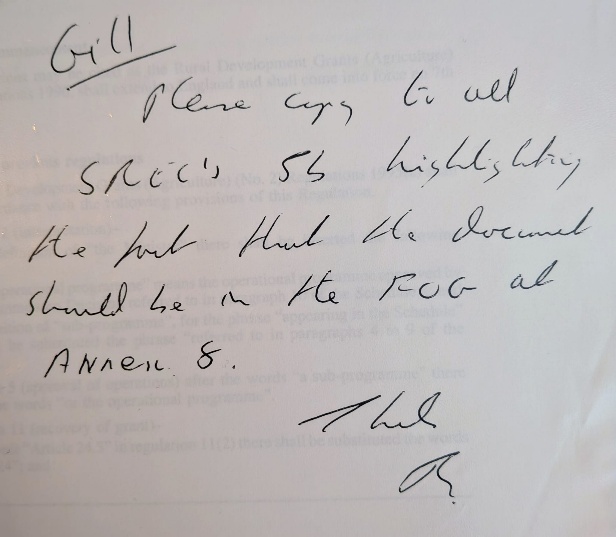
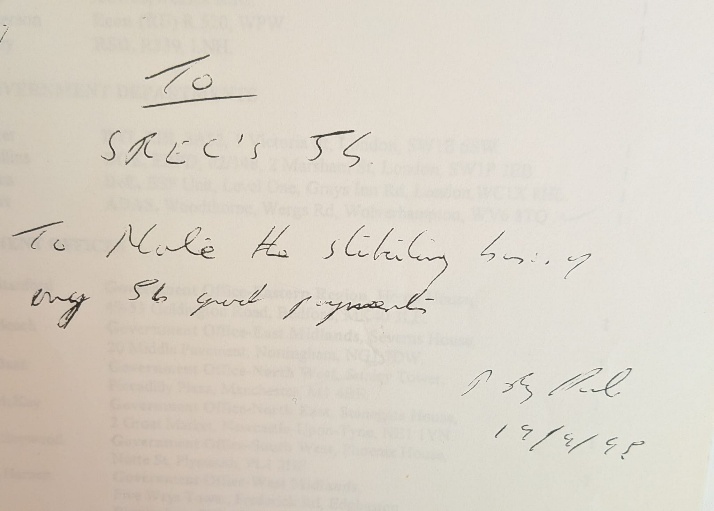
And then there was the handwriting. Truly appalling. In the era of memos, faxes, and brick-sized mobile phones, deciphering Roy’s notes was a daily test of ingenuity—but somehow, we always got there. The message always mattered more than the medium.
Roy was proud Devon farming stock, and he never missed an opportunity to promote Red Devon cattle. That grounded, practical farming perspective sat behind everything he did—principled, persistent, and utterly committed to rural places and people.
There was always laughter in Roy’s company, plenty of teasing, and a strong sense of shared purpose. I loved being part of “Roy’s gang,” and like many, would go the extra mile because he believed in us.
The rural economy owes a great deal to Roy Dart. I know I certainly do.
His legacy lives on in the programmes he helped shape, the networks he believed in, and the people he encouraged long before rural development had a name.
I’ll be raising a glass of good Devon cider to him. If this reaches others who had the privilege of working with Roy, I hope you’ll share your memories too.